





Every producing agent I know has had the same quiet thought in the last six months. Maybe I need to be on social more. Maybe I need a videographer on retainer. Maybe I should hire one of the brand people who keep showing up in my feed promising to make me the name in my market.
It usually arrives late at night, after a day where the deals were harder to come by than they used to be, and after scrolling past a newer agent with a ring light and a big follower count who somehow seems to be everywhere. The market tightened. The loud agents got louder. And the agent who built a real career on relationships starts to wonder whether the rules changed without telling anyone.
Mostly, they didn't. What changed is which signals actually move business, and most of the branding advice agents are hearing right now points at the wrong problem. Before you spend a dollar or an hour trying to fix your brand, it is worth being precise about what a brand does for a producer in a market like this, and what it doesn't.
What actually moves a listing in a tight market
When a seller chooses an agent in a slow market, they are not counting your followers. They are deciding whether they trust you to get a hard thing done in a year when it is genuinely hard to do. That trust comes from three places, and none of them live on a feed.
First is referral trust. A past client, or a friend of theirs, tells them you are the one to call. In a tight market that gets stronger, not weaker, because nervous sellers lean harder on people they already trust and tune out strangers selling themselves. Second is specific authority. Not “top producer,” which every agent claims, but a real and narrow reputation: the person who knows the east bench, or relocations, or one particular kind of property, better than anyone else they could call. Third is visible local expertise. Proof, in your own words, that you understand this market as it is right now, not a national headline reworded into a caption.
Notice what those three have in common. They are slow to build and hard to fake, which is exactly why they hold up when the market gets selective. A producer with a tight sphere, a clear niche, and something useful to say will out-list a louder agent with ten times the reach. After twenty years in this market, I have seen it go both ways.
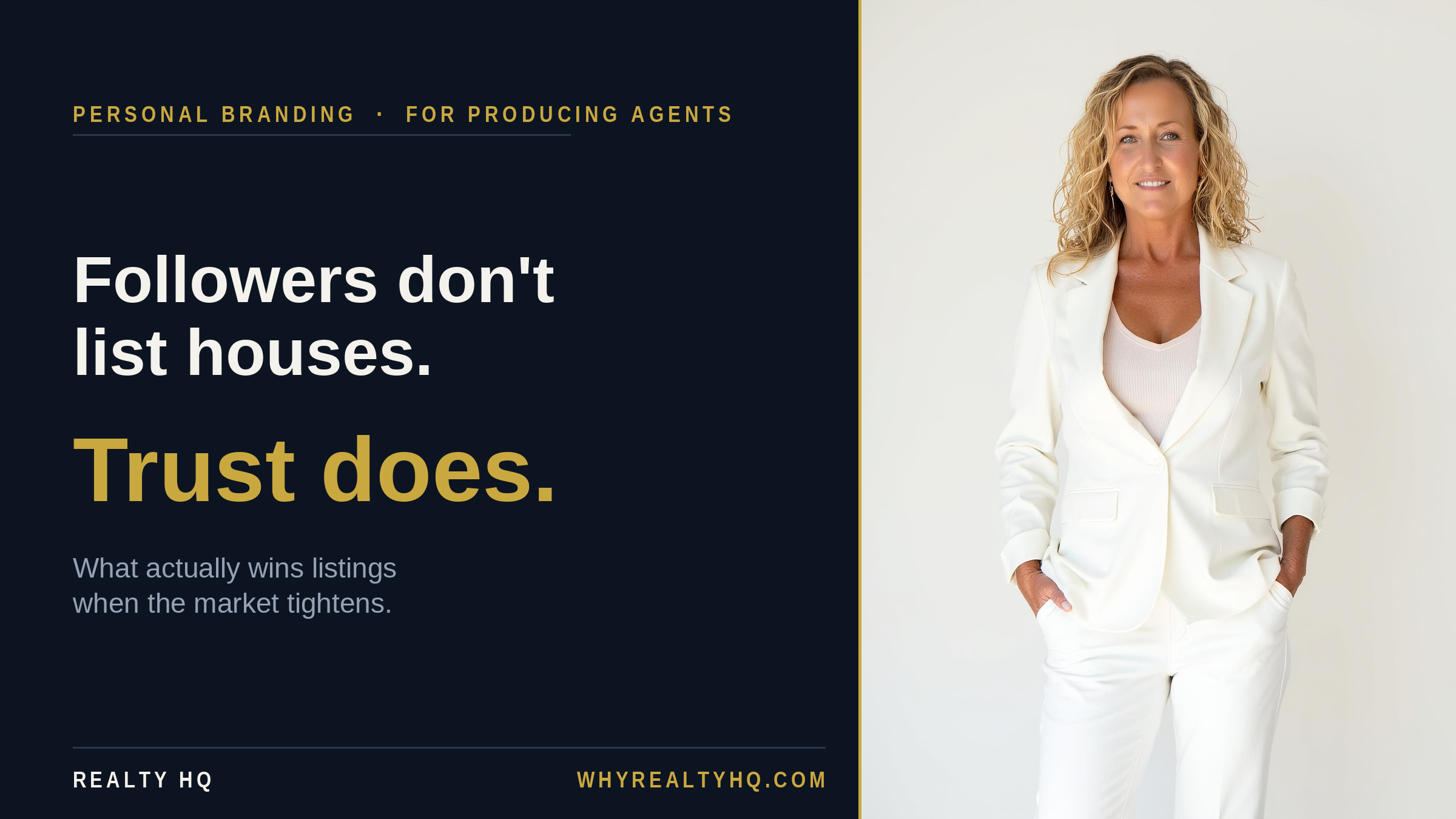
I’ve watched agents with a few hundred followers consistently win listings over agents with thousands because they had something far more valuable than reach: trust. The sellers knew them. Their past clients referred them. Their name came up in conversations long before an interview was ever scheduled. Social media can support that, but it rarely replaces it.
What looks like branding but isn’t
Here is the trap. Almost everything sold to agents as “personal branding” is built to win attention, and attention is not the thing holding a producer’s business back. You are competing for a finite number of listings against a small set of capable agents the seller is already weighing.
Most producing agents don’t have a visibility problem. They have a relationship problem, a consistency problem, or a follow-up problem. More content doesn’t automatically fix any of those.
Posting every day does not change that. Neither does a reel cut to a trending sound, or a coaching program that hands you the same hooks and scripts it handed three hundred other agents in three hundred other markets. When everyone runs the identical playbook, the playbook stops being an edge and turns into wallpaper. The agent posting daily who hasn’t closed in eight months is not a branding success you are somehow behind on. They are a reminder of how easy it is to confuse motion with progress.
This is not an argument against social media. It is an argument against treating volume as the goal. A producer’s brand problem is almost never “not enough content.” It is usually “nothing out there that only I could have made.”
Where your money and time actually compound
If you are going to invest in your brand this year, here is where the return is real for someone at your level.
- Professional photography of you, current and good. It shows up on every listing presentation, every profile, and every piece you ever publish, and it ages slowly. Cheap to do once, expensive to keep faking.
- A clean web presence on a domain you own. Not a page inside someone else’s platform that can rewrite its rules tomorrow, but a place with your name on it that you actually control.
- A market report you genuinely send. Quarterly, to your sphere, in plain language about the specific neighborhoods you work. That is niche authority and referral trust in a single habit, and almost nobody sustains it, which is the whole reason it works.
- One thing only you could write. A point of view about your market that a template could never generate. It does not need to be frequent. It needs to be yours.
What I would not spend a producer’s money on right now: paid brand coaches selling a universal formula, growth funnels built to inflate a follower number that has never once listed a house, and the script packs that make every agent in the country sound like the same person. Early in a career, borrowed structure can help. At your level, the thing that sets you apart is the one thing no one can sell you.
The question almost nobody asks: whose brand are you building?
There is a second cost to all of this that agents rarely add up, and as a broker it is the one I care about most.
When your web presence lives inside your brokerage’s site, when your leads sit in a database the brokerage owns and controls, and when the marketing you pay into every month builds a name with the brokerage’s logo on it, you are doing real brand work. You are just not doing it for yourself. You are a business, not an employee, pouring your own time and money into an asset that sits on someone else’s balance sheet. The day you leave, a lot of it stays behind.
A producing agent is a business, and a business should own its own brand. This is something I’ve learned over the course of my career. Brokerages change. Technology changes. Websites change. But the one asset that has followed me through every stage of my business is my reputation and the relationships I’ve built. That’s why I’ve always believed agents should invest in building a brand they own, not just one they borrow. Your name, your domain, your audience, the relationships you spent years earning. Those should be yours to take with you, because someday you may want to. The brokerage you work under should make that easier, not quietly compete with you for the relationship. So it is a fair question to ask wherever you hang your license: at the end of this year, whose brand got stronger on my dollar, mine or theirs?
Why a slow market is the right time, not the wrong one
The instinct in a down market is to wait. Trim the discretionary spend, keep the lights on, build the brand back up once business is good again. It feels responsible. It is backwards.
Brand compounds, and compounding rewards starting early far more than starting big. The producer who begins a clear positioning effort this summer has six months of stacked signal by the new year: a sphere that has heard from them four times, a market report people now expect, a point of view that is starting to travel. The producer who waits for the market to “come back” starts from zero at the precise moment everyone else does, when attention is expensive again and the early movers already hold the ground.
A slow market is the cheapest time to build a brand you will ever get. Your competitors are distracted or frozen, content costs less to make when you are not also juggling thirty transactions, and the relationships you tend now become the pipeline that closes when things turn. They always turn.
Where to start this week
You do not need a rebrand. You need one honest hour.
- Write down the one or two things you actually want to be known for. If the answer is “top producer,” keep going. That’s an outcome. What you really want to identify is why people should think of you first when they need an agent.
- Look at where your brand currently lives. How much of it sits on platforms and inside systems you do not own? Make a short list of what you would lose if you had to walk away tomorrow.
- Pick one compounding habit from the list above and start it this month. For most producers the quarterly market report is the highest return. One email, to people who already know you.
None of this needs permission, a bigger budget, or a louder feed. It needs a decision that the brand worth building is the one with your name on it, and then spending your time and money where that is actually true. And if part of that process leads you to evaluate how much of your marketing, brand, and income is helping build your business versus someone else’s, that’s a worthwhile exercise too. You can run your own numbers here. But start with the hour. The rest follows from getting clear about whose name you are building.
The observations here are general, drawn from two decades in Utah real estate, and are not a guarantee of results or business, financial, or tax advice for your specific situation. What works for your business depends on your market, your book, and your goals.
Lesley E. Mascaro, Principal Broker #5507521-PB00 | Realty HQ LLC, Brokerage #13775706-CN00


